How to Verify a Certification Body’s Accreditation Before Accepting an ISO Certificate
A supplier sends an ISO 9001 certificate.
The document looks professional, the certificate number is present, and the issuing organization appears legitimate.
Procurement checks the certification body online, finds that the company exists and records:
Accreditation rule: confirming that the certification body exists is not enough. Verify the accreditation relationship, relevant certification activity or scope and current status before relying on the supplier's ISO certificate in qualification.
ISO certificate verified.
That check is incomplete.
The important question is not only:
Does this certification body exist?
It is:
Is this certification body properly accredited for the certification activity shown on the supplier's certificate?
A practical verification chain looks like this:
Supplier
↓
ISO Certificate
↓
Certification Body
↓
Accreditation Body
↓
Relevant Accreditation / Recognition
The core procurement rule is:
Certification Body Exists ≠ Certification Body Is Accredited
And even when accreditation exists:
Accredited Somewhere ≠ Accredited for Every Certification Activity
Understand the Certification Chain First
Before searching databases, separate the different organizations involved.
Supplier
The company being certified.
For example:
ABC Building Materials Manufacturing Ltd.
Certification Body
The organization that audits the supplier and issues the management-system certificate.
For example:
XYZ Certification Ltd.
Accreditation Body
The organization that assesses whether the certification body is competent to carry out defined certification activities.
Recognition Framework
International accreditation arrangements may help connect participating accreditation bodies and accredited certification activities across markets.
The most important distinction for procurement is:
ISO publishes standards. ISO does not normally issue the supplier's ISO 9001, ISO 14001 or similar management-system certificate.
So seeing:
ISO 9001:2015
on a certificate does not tell you who verified the supplier.
You need to identify the certification body.
When Should Procurement Verify the Certification Body?
This additional check is particularly useful when:
- qualifying a new supplier;
- an ISO certificate is a mandatory RFQ requirement;
- the certification body is unfamiliar;
- the accreditation mark is unclear;
- the certificate is difficult to verify;
- certification is being used as a pass / fail qualification criterion;
- the supplier is high risk or commercially important;
- certificate authenticity has already raised concerns.
For a low-risk purchase, procurement may not need to investigate every certificate to the same depth.
But when ISO certification materially influences supplier approval, understanding the accreditation chain becomes important.
Step 1: Extract the Certificate Details
Before opening any accreditation database, record exactly what the supplier has provided.
| Field | Supplier Certificate |
|---|---|
| Supplier | ABC Manufacturing Ltd. |
| Standard | ISO 9001:2015 |
| Certificate No. | QMS-123456 |
| Certification Body | XYZ Certification Ltd. |
| Accreditation Body | AB Example |
| Scope | Manufacture of construction products |
| Issue Date | — |
| Expiry Date | — |
Capture:
- Supplier Legal Name
- Certification Standard
- Certificate Number
- Certification Body
- Certification Body Country
- Claimed Accreditation Body
- Accreditation Mark or Reference
- Certificate Issue Date
- Certificate Expiry Date
- Supplier Certification Scope
Do not mix these fields together.
A common mistake is treating:
Supplier
Certification Body
and
Accreditation Body
as if they were the same layer of evidence.
They are not.
Step 2: Confirm the Certification Body Identity
First determine who actually issued the certificate.
If supplier legal identity or company relationships are unclear, use the Supplier Due Diligence Checklist to resolve the entity question separately.
Compare the organization shown on the certificate against available official information.
Check:
- Official Organization Name
- Country
- Legal or Trading Name
- Website or Contact Information where useful
Possible outcomes:
CLEAR MATCH
The certification body identity is consistent.
→ Continue.
MINOR NAME DIFFERENCE
For example:
XYZ Certification
versus
XYZ Certification Services Ltd.
Determine whether this is simply a legal-name or trading-name difference.
MATERIAL DIFFERENCE
The certificate appears to name an entity that cannot be connected to the organization found.
→ HOLD
Do not proceed just because Google shows a company with a similar name.
Company-name similarity is not accreditation verification.
Step 3: Identify the Claimed Accreditation Body
Next identify who is supposedly accrediting the certification body.
Look for:
- Accreditation Body Name
- Accreditation Mark
- Accreditation Reference
- Accreditation Number where available
Be careful with logos.
A certificate may contain several marks:
- supplier logo;
- certification-body logo;
- accreditation mark;
- standard reference;
- other scheme marks.
Do not assume every logo means:
Accredited.
The procurement task is to distinguish:
Issued by
from:
Accredited by
Step 4: Search an Official Accreditation Resource
Now move to an appropriate official resource.
This check complements ISO Certificate Verification for Suppliers: first verify the certification body and accreditation chain, then return to the supplier's specific certificate for validity and scope review.
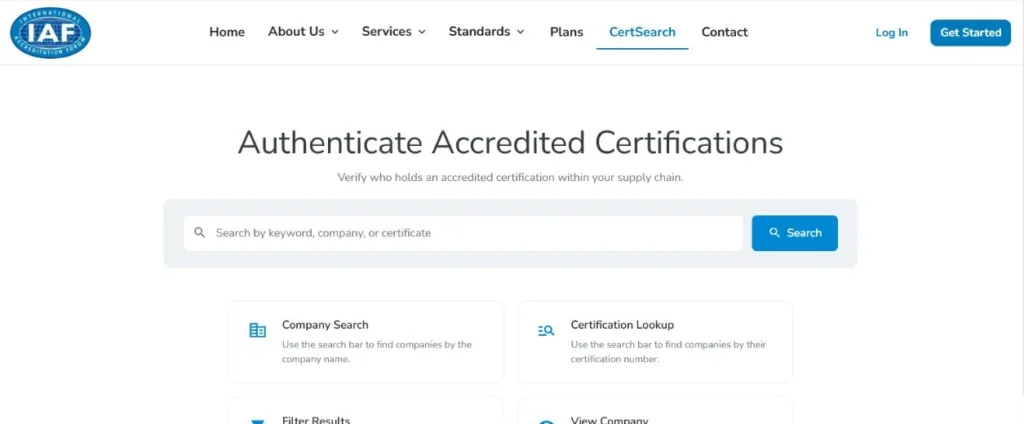
Depending on the certification and jurisdiction, procurement may use:
- IAF CertSearch;
- the relevant accreditation body's official directory;
- another official certification or accreditation database appropriate to the scheme.
Search using the strongest identifiers available:
- Certification Body Name
- Accreditation Body
- Certification Standard or Scheme
- Certificate Information where supported
Possible outcomes:
CERTIFICATION BODY FOUND
Continue.
CERTIFICATION BODY NOT FOUND
Use:
HOLD / INVESTIGATE
Do not automatically conclude that the body is fraudulent.
Possible reasons include:
- different legal name;
- spelling difference;
- database coverage limitations;
- outdated information;
- a different accreditation route;
- incorrect supplier documentation.
The verification goal is to establish the accreditation relationship, not simply to produce a search result.
Step 5: Confirm the Accreditation Relationship
This is the first hard accreditation gate.
Ask:
Does the official record show that this certification body is accredited by the accreditation body claimed on the supplier's certificate?
Use a comparison table.
| Field | Supplier Certificate | Official Record | Result |
|---|---|---|---|
| Certification Body | XYZ Certification | XYZ Certification | PASS |
| Accreditation Body | AB Example | AB Example | PASS |
| Country | UK | UK | PASS |
| Accreditation Status | Claimed Active | Active | PASS |
Possible results:
RELATIONSHIP CONFIRMED
→ Continue.
RELATIONSHIP UNCLEAR
→ HOLD
OFFICIAL RECORD CONTRADICTS CLAIM
→ NOT SUPPORTED
This is much stronger than simply writing:
Certification body exists.
Step 6: Check the Relevant Certification Activity
This is the most important part of the article.
Suppose XYZ Certification is genuinely accredited.
That still does not prove that every certificate it issues is covered by the same accreditation.
The next question is:
Accredited for what?
Check whether the official accreditation information supports the type of certification shown on the supplier certificate.
Possible fields include:
- Management-System Certification
- Relevant Standard or Scheme
- Accreditation Scope
- Sector or Technical Scope where applicable
- Accreditation Status
For example:
Supplier Certificate
ISO 9001:2015
Official Accreditation Record
Quality Management Systems Certification
This supports moving forward.
But suppose the official record only supports an unrelated certification activity.
Then:
HOLD / NOT SUPPORTED
Do not assume:
Accredited organization = authorized for every certification service it offers.
The key rule is:
A certification body can be properly accredited for one activity and still be outside its accreditation scope for another.
Accreditation Scope and Supplier Certificate Scope Are Different
This distinction prevents a lot of confusion.
Accreditation Scope
Answers:
What certification activities is the certification body competent and accredited to perform?
This is what B09 checks.
Supplier Certificate Scope
Answers:
Which activities, products, locations or operations of the supplier are covered by this specific certificate?
For example:
Certification body accreditation may cover:
Quality Management Systems Certification
while the supplier's certificate scope says:
Manufacture and supply of architectural glass and aluminium building products.
Both checks matter.
The first verifies the certification body.
The second verifies whether the supplier's own certified scope is relevant to what you are purchasing.
Certification-body accreditation verification does not replace supplier certificate verification.
Step 7: Check Accreditation Status and Timing
Record:
- Current Accreditation Status
- Search Date
- Relevant Effective Dates where available
Possible status:
ACTIVE
→ Continue.
SUSPENDED / WITHDRAWN / UNCLEAR
→ HOLD
Timing can become more complicated when the supplier certificate was issued in the past.
For example:
- certificate issued in 2024;
- certification body's accreditation status changed later;
- supplier certificate remains in circulation.
Do not automatically conclude that the older certificate was invalid.
Instead ask:
Was the certification body appropriately accredited for this activity when the certificate was issued, and does the certificate remain acceptable under the current supplier qualification requirement?
Escalate historical-status questions where necessary rather than inventing a conclusion.
Certification Body Verification Matrix
Use one matrix to document the review.
| Verification Field | Supplier Certificate | Official Accreditation Record | Status |
|---|---|---|---|
| Certification Body | XYZ | XYZ | PASS |
| Country | UK | UK | PASS |
| Accreditation Body | AB Example | AB Example | PASS |
| Certification Activity | ISO 9001 | QMS Certification | PASS |
| Accreditation Status | Claimed Active | Active | PASS |
| Search Date | — | YYYY-MM-DD | RECORD |
| Final Status | ACCREDITATION SUPPORTED |
This creates a stronger audit trail than:
Accreditation logo checked.
Step 8: Return to the Supplier Certificate
Once the certification body's accreditation appears supported, return to the actual supplier certificate.
Now verify separately:
- Supplier Legal Name
- Certificate Number
- Standard
- Certificate Status
- Expiry / Validity
- Supplier Site
- Certification Scope
- Relevant Operations
For example, a certification body may be properly accredited to issue ISO 9001 certificates.
But the supplier certificate may cover:
Sales and administration only
while procurement needs evidence covering:
Manufacturing activities.
That is no longer an accreditation-body problem.
It is a supplier certificate-scope problem.
This is why the workflow should be:
Certification Body Accreditation
↓
Supplier Certificate Verification
not:
Certification Body Accredited
↓
Supplier Automatically Approved
Certification Body Accreditation Verification Checklist
Supplier Certificate
- Supplier legal name recorded
- Standard recorded
- Certificate number recorded
- Certification body identified
- Claimed accreditation body identified
Certification Body
- Official identity checked
- Country checked
- Name differences resolved
Accreditation
- Official accreditation resource checked
- Accreditation-body relationship confirmed
- Accreditation status reviewed
- Relevant certification activity reviewed
- Scope appears applicable
Final Result
ACCREDITATION SUPPORTED
HOLD / CLARIFY
NOT SUPPORTED
Accreditation Verification Decision Gate
Supplier ISO Certificate Received
↓
Certification Body Identified?
NO
→ HOLD
YES
↓
Certification Body Found in an Appropriate Official Resource?
NO
→ HOLD / INVESTIGATE
YES
↓
Accreditation Relationship Confirmed?
NO
→ HOLD
YES
↓
Relevant Certification Activity Supported?
NO
→ NOT SUPPORTED
UNCLEAR
→ HOLD
YES
↓
Accreditation Status Acceptable?
NO / UNCLEAR
→ HOLD
YES
↓
CERTIFICATION BODY ACCREDITATION SUPPORTED
↓
Return to Supplier Certificate Verification
What If the Certificate Shows an IAF-Related Logo?
Do not use the logo alone as the verification result.
A mark can help identify the claimed accreditation chain, but procurement should still confirm:
- Certification Body
- Accreditation Body
- Accreditation Relationship
- Relevant Certification Scope
- Current Status
The practical rule is:
Logos indicate a claim. Official records support verification.
What If the Certification Body Is Not Found in IAF CertSearch?
Do not automatically conclude:
Certificate invalid.
Instead use a controlled sequence.
1. Recheck the Certification Body Name
Look for:
- full legal name;
- former name;
- spelling variants.
2. Identify the Accreditation Body
Use the accreditation information shown on the certificate.
3. Search the Accreditation Body's Official Directory
The relevant body may provide its own accredited-organization search.
4. Confirm Database Coverage
Not every certification activity or historical record should be assumed to appear in every database in exactly the same way.
5. Ask for Clarification
Request additional accreditation information from:
- supplier;
- certification body;
- accreditation body where necessary.
Until resolved:
HOLD
This is safer than treating one unsuccessful search as proof of fraud.
Accredited Certification Does Not Mean Supplier Qualified
Even when both:
Place the certificate evidence back into the wider Supplier Qualification Workflow and the Supplier Qualification Checklist Before RFQ before commercial commitment.
- the certification body accreditation; and
- the supplier certificate
pass verification, supplier qualification is still not complete.
An ISO management-system certificate does not automatically prove:
- Product Quality
- Production Capacity
- Delivery Reliability
- Financial Stability
- Product Compliance
- Project-Specific Capability
- Technical Performance
The broader workflow remains:
Supplier Documents
↓
Certification Body Accreditation
↓
Supplier ISO Certificate Verification
↓
Supplier Qualification Criteria
↓
Audit / Additional Verification Where Required
↓
Supplier Approval
Certification is one evidence layer.
It should not replace the rest of supplier due diligence.
Common Certification Body Verification Mistakes
Assuming ISO Issued the Supplier Certificate
ISO publishes standards; certification bodies conduct certification.
Checking Only Whether the Certification Body Exists
Existence is not accreditation.
Stopping After Seeing an Accreditation Mark
Verify the official accreditation relationship.
Ignoring Accreditation Scope
An accredited organization is not automatically accredited for every certification activity.
Confusing Accreditation Scope With Supplier Certificate Scope
They answer different questions.
Treating Certification-Body Accreditation as Proof of a Specific Supplier Certificate
The supplier certificate still requires its own verification.
Treating ISO Certification as Full Supplier Qualification
Certification is only one supplier-control input.
Accreditation Verification Record
Keep a dated record.
| Field | Record |
|---|---|
| Supplier | ABC Manufacturing |
| Standard | ISO 9001 |
| Certificate Number | — |
| Certification Body | XYZ Certification |
| Accreditation Body | — |
| Official Resource Checked | — |
| Search Date | — |
| Accreditation Status | — |
| Relevant Certification Scope | — |
| Final Status | Supported / Hold / Not Supported |
| Reviewer | — |
| Notes | — |
This creates a useful verification trail if the supplier qualification decision is later reviewed.
Where Certification Body Verification Fits in Supplier Qualification
A practical supplier workflow is:
Higher-risk suppliers may still require the Supplier Audit Checklist, while qualified candidates can later be compared with the Construction Supplier Evaluation Scorecard.
Collect Supplier Information
↓
Supplier Provides ISO Certificate
↓
Verify Certification Body Accreditation
↓
Accreditation Supported?
NO / UNCLEAR
→ HOLD
YES
↓
Verify Specific Supplier ISO Certificate
↓
Certificate Valid and Relevant?
NO
→ HOLD
YES
↓
Apply Supplier Qualification Criteria
↓
Audit / Additional Verification Where Required
↓
APPROVED
CONDITIONALLY APPROVED
HOLD
REJECTED
This gives accreditation verification a clear role without allowing it to replace the wider qualification process.
Tools and Resources for Certification Body Verification
Procurement teams may use:
- IAF CertSearch
- Accreditation Body Directories
- Certification Verification Databases
- Supplier Verification Resources
- ISO / Standards Resources
- Supplier Qualification Checklists
- Supplier Audit Tools
These resources answer different questions.
An accreditation directory helps verify the certification body.
A certificate database helps verify the supplier's specific certificate.
A company registry helps confirm the supplier's legal identity.
A qualification checklist determines whether the supplier should actually be approved.
Build Procurement Hub organizes these resources around the supplier-verification workflow so buyers can move from an ISO certificate to the appropriate accreditation source, confirm the issuing body's status and then return to supplier qualification.
Verify the Accreditation Chain — Then Return to the Supplier Certificate
Identify the certification body, confirm the claimed accreditation body through an appropriate official resource, check the relevant certification activity and accreditation status, then return to the supplier's own certificate to verify legal name, validity, site and scope before using it in supplier qualification.
FAQ
How can I verify whether an ISO certification body is accredited?
Identify the certification body and claimed accreditation body from the supplier certificate, then check an appropriate official accreditation resource and confirm that the accreditation supports the certification activity being claimed.
Does an accredited certification body mean every certificate it issues is valid?
No. Accreditation supports the certification body's competence for defined certification activities. The supplier's specific certificate still needs its own validity and scope review.
Is finding the certification body in an accreditation database enough?
No. Procurement should also verify the accreditation relationship, current status and relevant certification activity or scope.
What should procurement do if the certification body's accreditation is unclear?
Keep the evidence on HOLD, check additional official accreditation resources and request clarification before using the certificate as supplier-qualification evidence.
The core principle is:
Do not accept a certification body simply because its name appears on an ISO certificate. Verify that the body is accredited through an appropriate accreditation body and that the relevant accreditation supports the certification activity claimed on the supplier's certificate.
