How to Verify Construction Standards Before Material Approval: ASTM, ISO, ICC and Local Code Checks
Construction procurement teams often receive supplier documents containing statements such as:
Complies with ASTM XXXX.
or:
Standards-verification rule: start from the project requirement, identify the exact standard, verify it through an authoritative source, confirm scope and edition, check local approval requirements, and only then evaluate whether the supplier's evidence supports material approval.
Tested according to ISO XXXX.
Those statements may look reassuring, but they do not answer the most important procurement question:
Is this actually the standard required for this product and this project?
Before material approval, procurement should separate three different issues:
- What standard or code does the project require?
- Does that standard actually apply to the product being purchased?
- Does the supplier's evidence demonstrate the required compliance?
A standard number printed on a technical data sheet is only a starting point.
Standard Identified ≠ Product Compliant
A reliable review should move from the project requirement to the authoritative standards source, then to the supplier evidence.
Why Supplier Standards Claims Need Verification
Consider a supplier submitting a product data sheet stating:
Tested to ASTM X123.
But the project specification requires:
ASTM X456 and applicable local approval.
The procurement team should not record:
ASTM compliant.
There is still a mismatch to resolve.
ASTM X123 may be:
- a related test method;
- a different product standard;
- a test for only one performance property;
- or simply unrelated to the contractual requirement.
The real task is not to decide whether ASTM is reputable.
The task is:
Does the supplier's evidence match the project's actual requirement?
That distinction is the foundation of standards verification.
Start With the Project Requirement, Not the Supplier Document
The supplier should not define the compliance requirement simply by submitting whichever standard it already has.
Start with the project documents.
Relevant sources may include:
- Project Specifications
- Drawings
- Employer or Client Requirements
- Material Schedules
- Contract Documents
- Approved Technical Requirements
- Applicable Local Codes or Regulations
The first question should be:
What does the project actually require this product to comply with?
Only after that requirement is clear should procurement assess the supplier's documents.
Supplier evidence should be checked against the project requirement — not used to define the project requirement.
This also prevents a common sourcing problem: accepting an easier or more familiar standard simply because the supplier already has a report for it.
Step 1: Identify the Standard Reference Correctly
Avoid recording vague claims such as:
ASTM compliant
or:
Meets international standards.
Where available, identify the exact reference, including:
- Standards Organization
- Standard Number
- Relevant Part or Section
- Edition or Year
- Test Method
- Product Standard
The difference matters.
For example, a supplier may reference a test method, while the project specification requires compliance with a broader product standard.
Those are not automatically equivalent.
Procurement needs enough information to identify exactly what is being claimed.
Step 2: Verify the Standard Through an Authoritative Source
Once the standard reference is known, check it through the relevant authoritative source.
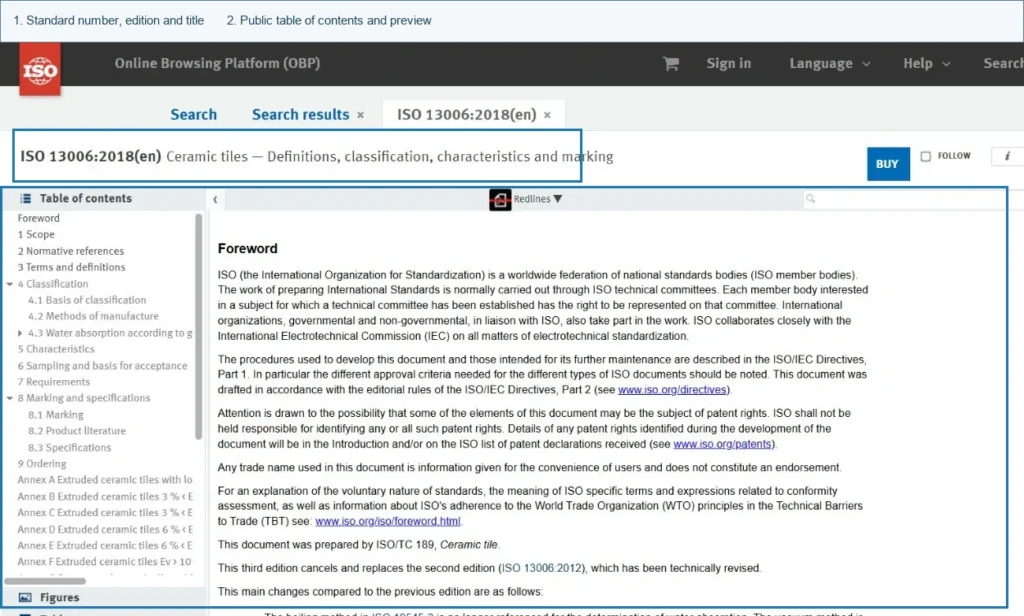
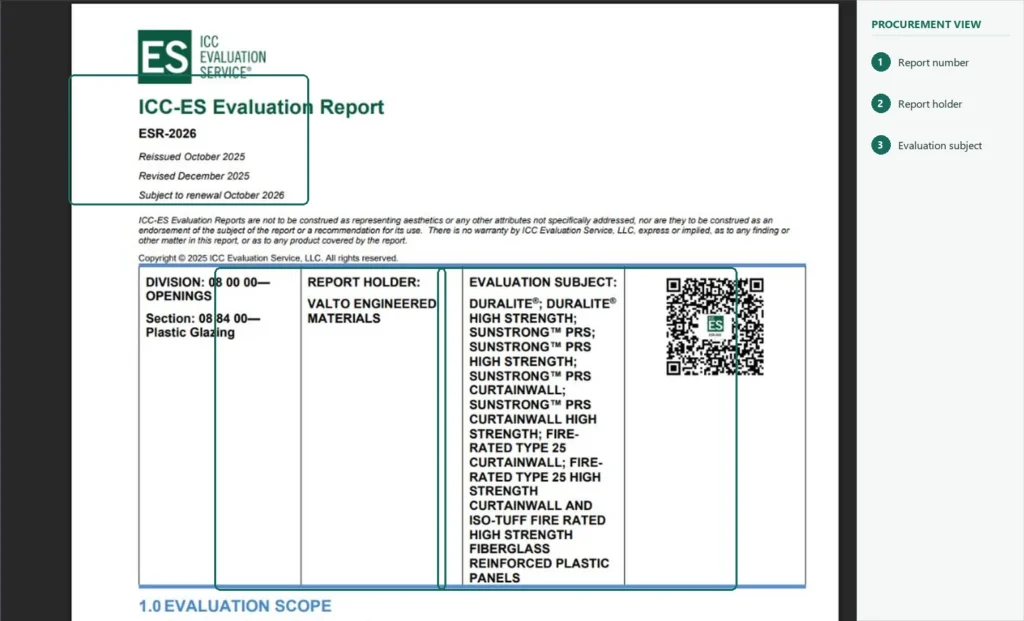
If the project relies on an evaluation report rather than a simple standard reference, use How to Verify an ICC-ES Evaluation Report to review the product, scope and conditions through the official source.
Depending on the requirement, this may include:
ASTM
Use the official ASTM standards source to confirm the standard title, scope and available edition information.
ISO
Use the official ISO standards catalogue.
ICC or Building Codes
Use the relevant official code or evaluation source.
Local Codes
Use the official authority or recognized code source for the project jurisdiction.
The important principle is:
Do not rely only on a supplier PDF, copied standard title or search-engine snippet.
A supplier may have used:
- an outdated title;
- an incomplete reference;
- a standard covering a different product;
- or an old report referring to another edition.
The authoritative source helps establish what the standard actually is.
Step 3: Confirm That the Standard Scope Matches the Product
Finding the correct standard number is still not enough.
Procurement also needs to understand what the standard covers.
A standard may govern:
- Product Requirements
- Test Methods
- Material Properties
- Installation
- Classification
- Performance
- Terminology
This distinction is especially important when reviewing test reports.
A supplier may say:
Tested according to ASTM X123.
But ASTM X123 may only define how one characteristic is tested.
The project may instead require compliance with a broader product standard that references several separate tests.
Related Standard ≠ Applicable Standard
The practical question is:
Does this standard govern the requirement being reviewed for this specific product?
Product Standard vs Test Method vs Code Requirement
These three concepts should not be treated as interchangeable.
Product Standard
Defines requirements or characteristics for a type of product.
Test Method
Defines how a specific property or performance characteristic is measured.
Code or Regulatory Requirement
Defines what the project or jurisdiction requires.
They may connect to one another.
A simplified relationship may look like:
Code Requirement → Product Requirement → Test Method → Test Evidence
For procurement, this matters because receiving a test report does not automatically demonstrate full product compliance.
The report may prove only one piece of the requirement.
Step 4: Check the Edition or Referenced Version
A standard number may exist in several editions.
The current published version is not always the same as the version required by the project.
The project specification, contract or adopted code may reference:
- a specific year;
- a specific edition;
- a version incorporated into a local code;
- an older contractual requirement.
Therefore procurement should distinguish:
Current Standard
What the standards organization currently publishes.
from:
Project-Required Standard
What the contract or authority requires for this project.
Newest Edition ≠ Automatically the Contract Requirement
Procurement should not unilaterally replace the specified edition just because a newer version exists.
Where the requirement is unclear, raise a technical clarification.
Step 5: Check Local Codes and Approval Requirements
A product may comply with an ASTM or ISO requirement and still require additional local approval.
Depending on the product and jurisdiction, the project may also require:
- Local Building Code Compliance
- Product Approval
- Technical Evaluation
- Mandatory Certification
- Authority Acceptance
- Other Project-Specific Evidence
This is why:
International Standard ≠ Automatic Local Approval
A supplier may have a valid test report against an international standard, but that report may not be sufficient for the authority having jurisdiction or for the project's approval process.
Procurement should therefore check both:
technical-standard requirement
and:
project / jurisdiction approval requirement.
Step 6: Match the Supplier Evidence to the Requirement
Only after the requirement is clear should procurement decide whether the supplier's documents actually support it.
Where the evidence is a product certificate or listing, continue with Construction Product Certification for Procurement rather than assuming the standards check has already verified the certificate itself.
Evidence may include:
- Test Report
- Certificate
- Declaration
- Evaluation Report
- Product Listing
- Technical Data
Then compare:
Required Standard
with:
Standard Shown on the Evidence
and:
Required Product
with:
Product or Model Covered by the Evidence
A matching standard reference alone is not enough.
Check More Than the Standard Number
Suppose the project is purchasing:
Model A
but the supplier provides a test report for:
Model B.
Both products may refer to the same ASTM standard.
That does not automatically mean the report applies to Model A.
Procurement may also need to compare:
- Manufacturer Name
- Product / Model
- Material Grade
- Size or Configuration
- Test Date
- Laboratory
- Report Number
- Scope of Test
- Relevant Results
Correct Standard ≠ Correct Product Evidence
The evidence needs to connect to the product actually being approved.
Applicable Standard Verification Path
A practical review sequence is:
Project Specification / Local Requirement
↓
Identify Required Standard
↓
Verify Standard in an Authoritative Source
↓
Confirm Standard Scope Matches the Product
↓
Check Edition / Referenced Version
↓
Check Local Code / Approval Requirements
↓
Match Supplier Evidence to the Requirement
↓
Confirm Product / Model / Scope
↓
Record the Material Approval Basis
If the evidence does not align with the requirement:
Clarify before approval.
Do not fill the gap with an assumption.
Example: Supplier Claims ASTM Compliance
Suppose a project specification requires:
ASTM X456
plus:
applicable local product approval.
The supplier submits:
Technical Data Sheet — Tested to ASTM X123
and:
Test Report TR-001.
Procurement should review the submission in sequence.
Check 1 — Project Requirement
The project requires:
ASTM X456.
Check 2 — Supplier Evidence
The supplier references:
ASTM X123.
There is already a difference.
Check 3 — Scope
Procurement should determine whether X123 is:
- a test method referenced by X456;
- complementary evidence;
- a different product requirement;
- or irrelevant to the required approval.
Check 4 — Local Approval
The project also requires local product approval, so separate evidence may be needed.
The correct conclusion is not:
Supplier failed.
and not:
ASTM compliant.
It is:
Requirement not yet demonstrated — clarification or additional evidence required.
That is a much stronger procurement record.
What If the Supplier Provides a Different Standard?
Another common situation is:
Project specifies:
ASTM requirement.
Supplier proposes:
ISO or EN equivalent.
Procurement should not automatically decide:
equivalent.
Possible action:
- Record the different standard.
- Request the supplier's equivalency basis.
- Submit it to the responsible technical reviewer, consultant or approval authority.
- Record the decision.
Alternative Standard ≠ Automatically Equivalent Standard
Procurement can coordinate the evidence, but technical equivalency may require formal approval.
What Should Be Recorded Before Material Approval?
A traceable approval record should normally show the connection between:
Carry the verified requirement and evidence basis into the Construction Material Submittal Process and then record the final approved basis in the Material Approval Register.
specification → standard → evidence → approval.
Useful information may include:
- Project Requirement
- Applicable Standard
- Authoritative Source Checked
- Edition / Version where relevant
- Supplier Evidence Reference
- Product / Model Covered
- Local Approval Requirement
- Technical Clarification
- Final Approval Reference
This does not require creating another complicated tracker.
The goal is simply to make the approval basis clear enough that another team member can understand why the material was accepted.
Standards Verification and Evidence Verification Are Different Tasks
These tasks are connected, but they answer different questions.
If the next question is whether the testing source is suitable, use How to Find an Accredited Laboratory; if the evidence depends on an ISO certification body, use Certification Body Accreditation Verification.
Standards Verification
What requirement applies?
Certificate Verification
Is this certification claim valid and relevant?
Test Report Verification
Does this report provide acceptable evidence for the required test?
Laboratory Verification
Was the relevant testing performed by a suitable laboratory for the required scope?
This distinction helps procurement avoid trying to answer every compliance question with one document.
A certificate, test report, declaration and evaluation report may each prove different things.
Common Standards Verification Errors
Accepting Any Recognized Standard
A respected standard can still be irrelevant to the product or project.
Checking Only the Standard Number
The scope and product coverage matter.
Assuming the Latest Edition Must Be Used
The contract or adopted code may reference a different edition.
Treating One Test Report as Full Product Compliance
A report may cover only one characteristic.
Assuming ASTM or ISO Replaces Local Requirements
Additional approval or code requirements may apply.
Treating Alternative Standards as Automatically Equivalent
Equivalency may require a technical decision.
Where Build Procurement Hub Fits
Standards verification often requires several different resources.
Within Standards & Codes, procurement teams may need access to:
- ASTM standards sources;
- ISO standards catalogues;
- ICC and code resources;
- local code resources.
Within Product Certification, the next task may involve:
- certification databases;
- product listings;
- declarations;
- evaluation reports.
Within Supplier Verification, teams may need:
- accredited laboratory resources;
- certification-body verification;
- company verification.
And within Project Documents & Submittals, the verified requirement ultimately feeds into:
- material approval;
- submittal records;
- approval registers.
Build Procurement Hub helps procurement teams move from:
Which standard is being referenced?
to:
Which authoritative source should I check, what evidence should I verify next, and where should the approval result be recorded?
Verify the Requirement Before You Verify the Supplier Evidence
Start from the project specification or local requirement, identify the exact standard, confirm it through an authoritative source, check scope and edition, review local approval requirements, and only then decide whether the supplier's test report, certificate, declaration or evaluation record actually supports material approval.
FAQ
How do I verify an ASTM standard used for a construction product?
Start with the project requirement, identify the exact ASTM reference, check the standard title and scope through an authoritative ASTM source, and then determine whether the supplier evidence covers the required product and requirement.
Does a test report prove that a construction product complies with a standard?
Not necessarily. A test report may cover only one test method or characteristic. Procurement should confirm that the report matches the required standard, product and approval scope.
Should procurement always require the latest edition of a standard?
Not automatically. The project specification, contract or adopted code may reference a particular edition. Unclear differences should be clarified rather than changed without approval.
If a product meets ASTM or ISO requirements, does that mean it is approved for the project?
No. Local code, product approval, certification and project-specific requirements may also apply.
Can a supplier use ISO or EN evidence when the specification requires ASTM?
Possibly, but procurement should not assume equivalency. The alternative standard should be documented and reviewed by the appropriate technical or approval authority.
The core principle is:
Construction-standard verification starts with the project requirement, not the supplier's claim. Confirm the applicable standard through an authoritative source, verify that its scope and edition fit the project, check any local requirements, and only then determine whether the supplier's test report, certificate, declaration or evaluation record actually supports material approval.
