How to Find an Accredited Laboratory for Construction Material Testing: Which Official Directory to Use
A project specification requires a construction-material test.
Procurement searches Google for:
“Best construction material testing laboratory”
Laboratory-selection rule: do not choose a testing company by brand or ISO/IEC 17025 claim alone. Verify the exact laboratory site and confirm that the required product, test method, standard, range and project acceptance are all covered before booking the test.
finds a well-known testing company, sees ISO/IEC 17025 Accredited on its website and sends the samples.
That can still be the wrong laboratory.
ISO/IEC 17025 is the international standard used by testing and calibration laboratories to demonstrate competence and the ability to produce valid results. But laboratory accreditation applies to defined activities, not automatically to every test a laboratory offers.
The real procurement question is therefore:
Is the exact laboratory site accredited for the specific product, test method and standard required by this project?
A practical search workflow is:
Define Required Test
↓
Identify Relevant Accreditation Route
↓
Find the Appropriate Accreditation Body
↓
Search Its Official Laboratory Directory
↓
Confirm Exact Laboratory Site
↓
Open Scope of Accreditation
↓
Check Product + Test Method + Standard + Range
↓
Confirm Project Acceptance
↓
SUITABLE
The laboratory can be considered for the test request.
HOLD / CLARIFY
Scope or project acceptance remains unclear.
NOT SUITABLE
The required test is outside the accredited scope.
The key rule is:
Laboratory Accredited ≠ Every Test Is Accredited
Step 1: Define the Test Before Looking for a Laboratory
Do not begin with:
Treat laboratory selection as one supporting evidence task inside the wider Construction Product Certification for Procurement workflow.
“Find us an accredited testing lab.”
First define exactly what needs to be tested.
Record:
- Product / Material
- Required Test
- Test Standard
- Standard Edition where relevant
- Required Classification / Result
- Project Specification Reference
- Regulatory Requirement where applicable
- Required Recognition
- Testing Location where relevant
For example:
| Field | Requirement |
|---|---|
| Product | Fire Door |
| Test | Fire Resistance |
| Standard | Required EN / ASTM method |
| Required Result | Classification X |
| Project | Project A |
| Accreditation | Accredited test required |
This matters because a laboratory search should start from:
Which test capability do we need?
not:
Which laboratory has the strongest brand?
Why ISO/IEC 17025 Accreditation Alone Is Not Enough
ISO/IEC 17025 covers the competence, impartiality and consistent operation of testing and calibration laboratories.
But accreditation is granted for a defined scope of accreditation.
NATA, for example, explicitly describes accreditation as being granted for a specific scope that represents an organisation's accredited capabilities.
That means a laboratory may be accredited for:
- mechanical testing;
- chemical analysis;
- dimensional testing;
but not for:
- fire resistance testing.
So this statement:
“The laboratory is ISO/IEC 17025 accredited.”
does not answer:
“Is my required test accredited?”
Always continue to the detailed scope.
Step 2: Determine Which Accreditation Route Matters
Before searching individual laboratories, identify the accreditation environment relevant to the project.
Ask:
- In which country will the testing be performed?
- Does the project specify a particular accreditation body?
- Does a regulator require recognised accreditation?
- Does the result need international recognition?
- Does the consultant maintain an approved-laboratory requirement?
Since 2026, the international accreditation structure has been brought together under Global Accreditation Cooperation Incorporated — Global ACI, which incorporates the international accreditation work previously carried through ILAC and IAF. Global ACI's Multilateral Recognition Arrangement includes Testing as one of its main recognition scopes.
A useful navigation route is:
Global ACI
↓
Relevant Recognised Accreditation Body
↓
Accreditation Body's Official Laboratory Directory
↓
Exact Laboratory
↓
Scope of Accreditation
Global ACI helps identify the recognition route. Procurement normally still needs the accreditation body's own directory to verify a particular laboratory.
Step 3: Use the Correct Official Laboratory Directory
Different markets use different official accreditation resources.
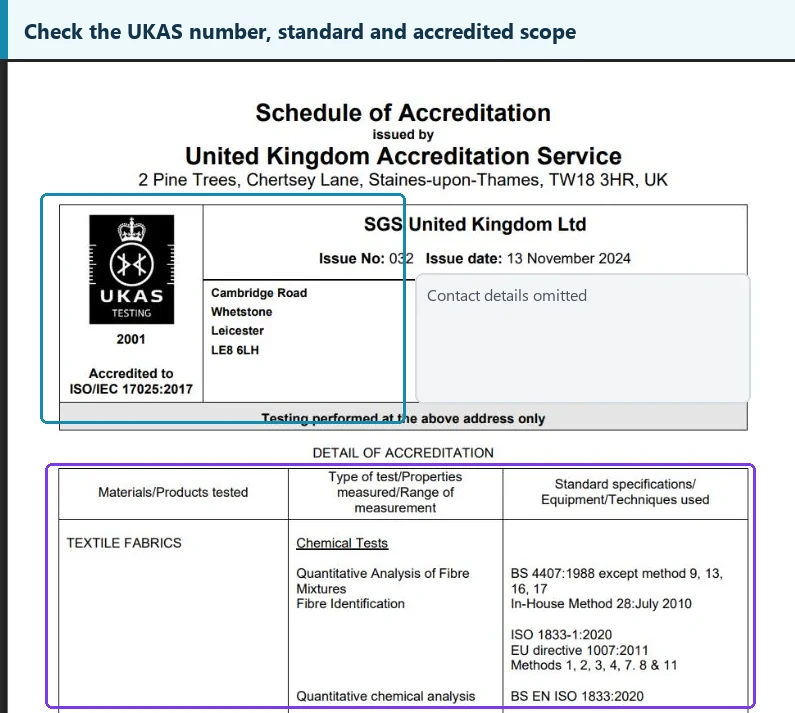
Examples include:
United Kingdom — UKAS
UKAS provides a searchable directory of accredited organisations and supports browsing by organisation type and category, including laboratory accreditation.
United States — A2LA
A2LA maintains an official Directory of Accredited Organizations, including ISO/IEC 17025 testing and calibration laboratories.
Australia — NATA
NATA provides an official accredited-organisation search and individual laboratory pages containing detailed scopes of accreditation.
These are not rankings.
The correct directory depends on:
- project country;
- testing location;
- specified accreditation requirements;
- recognition requirements.
A simple starting map is:
| Situation | Starting Resource |
|---|---|
| Need international accreditation-body route | Global ACI |
| UK laboratory search | UKAS |
| A2LA-accredited U.S. laboratory | A2LA |
| Australian laboratory search | NATA |
| Other country | Relevant recognised accreditation body's official directory |
| Project names an accreditation body | Use that body's official directory |
Use the international recognition network to identify the accreditation route; use the accreditation body's own records to verify the laboratory.
Step 4: Confirm the Exact Laboratory Site
Do not verify only the testing-company brand.
A large testing organisation may operate:
- several countries;
- multiple cities;
- different laboratories;
- specialist departments.
Their accreditation scopes may not be identical.
Record:
- Legal Organisation Name
- Laboratory Site
- Address
- Accreditation Number
- Accreditation Standard
- Current Status
For example:
Proposed Testing Site
ABC Testing — Shanghai
Official Accreditation Record
ABC Testing — Guangzhou
Do not assume the Shanghai laboratory automatically inherits Guangzhou's accreditation.
Use:
EXACT SITE CONFIRMED
→ Continue.
SITE UNCLEAR
→ HOLD
Real accreditation records can be site-specific. NATA's public records, for example, identify both accreditation numbers and individual site numbers and addresses.
Verify the facility that will actually perform the test.
Step 5: Open the Scope of Accreditation
This is the most important step.
Once the laboratory is found, locate its detailed accredited scope.
The scope may identify fields such as:
- Material / Product
- Testing Activity
- Determinant
- Technique
- Test Method
- Standard
- Procedure
- Range
- Limitations
- Laboratory Site
NATA's public construction-material laboratory records, for example, can list specific products, testing activities, techniques and standards rather than merely stating that the laboratory is accredited.
The question is:
Is the exact test required by the project inside this scope?
Laboratory Scope Verification Matrix
Use a simple comparison table.
| Verification Field | Project Requirement | Laboratory Scope | Status |
|---|---|---|---|
| Material / Product | Product X | Product X | PASS |
| Test Activity | Test A | Test A | PASS |
| Standard | EN / ASTM XXX | Same | PASS |
| Method | Method A | Method A | PASS |
| Standard Edition | Required | Listed | REVIEW |
| Laboratory Site | Site A | Site A | PASS |
| Range / Limitation | Required range | Covered | PASS |
| Final Status | SUITABLE |
This table is much stronger than:
ISO 17025 ✓
Step 6: Check the Exact Standard and Test Method
Similar test names do not necessarily mean the same accredited activity.
Suppose the project requires:
ASTM XXXX — Method A
but the laboratory's scope includes:
ASTM XXXX — Method B
Do not automatically pass the lab because the same standard number appears.
Use:
EXACT METHOD MATCHES
→ PASS.
METHOD RELATIONSHIP UNCLEAR
→ HOLD / TECHNICAL REVIEW.
DIFFERENT METHOD
→ NOT SUITABLE unless the project accepts the alternative.
Check:
- Standard Number
- Test Method
- Procedure
- Product Type
- Classification Method
- Relevant Edition
The standard family may match while the accredited test method does not.
What If the Standard Edition Is Different?
A project may specify:
2024 edition
while the laboratory scope references:
2019 edition
Do not automatically reject the laboratory.
Use:
HOLD / TECHNICAL REVIEW
Check whether:
- the accreditation scope has since been updated;
- the newer edition is already covered elsewhere in the scope;
- the editions are acceptable under the project's requirements;
- the consultant or regulator accepts the referenced version.
Procurement's job is to identify the discrepancy.
The responsible technical authority should determine whether it is acceptable.
Step 7: Check Range and Other Limitations
Even when the test method matches, the accredited scope may contain limits.
Check where relevant:
- Product Size
- Load Range
- Temperature Range
- Material Type
- Test Configuration
- Measurement Range
- Laboratory vs On-Site Testing
- Other Conditions
Example:
Project Requires
Testing to:
100 kN
Laboratory Scope
Maximum accredited range:
50 kN
Result:
NOT SUITABLE
The test name matches, but the project requirement falls outside the accredited capability.
Correct test method + wrong accredited range can still mean the lab is unsuitable.
Step 8: Confirm That the Project Will Accept the Result
Accreditation is an important quality and competence control, but it does not automatically override project-specific requirements.
Where the test method, standard edition or acceptance route affects supplier technical compliance, record the issue in the Technical Bid Evaluation Template before commissioning the test.
Before ordering testing, ask:
- Does the consultant accept this accreditation body?
- Does the authority require local accreditation?
- Is a specific named laboratory required?
- Is witnessed testing required?
- Is a specific report format required?
- Is international recognition required?
Global ACI's MRA is designed to support international confidence and mutual recognition of accredited conformity-assessment results, but individual projects and regulators may still impose their own acceptance rules.
Use:
PROJECT ACCEPTS
→ Continue.
ACCEPTANCE UNCLEAR
→ HOLD
PROJECT DOES NOT ACCEPT
→ Find another laboratory.
Correct accreditation scope does not automatically mean automatic acceptance by every project.
Accredited Laboratory Search Route
Use this navigation workflow:
Define Product + Required Test
↓
Identify Country / Recognition Requirement
↓
Global ACI
↓
Relevant Accreditation Body
↓
Official Accredited Laboratory Directory
↓
Exact Laboratory Site
↓
Scope of Accreditation
↓
Exact Test / Standard Covered?
NO
→ Find another laboratory.
YES
↓
Range / Conditions Covered?
NO
→ Find another laboratory.
YES
↓
Project Accepts Result?
NO
→ Find an acceptable laboratory.
YES
↓
LABORATORY SUITABLE FOR TEST REQUEST
Step 9: Request Evidence Before Booking the Test
Once a laboratory appears suitable, confirm the test commercially and technically.
Request:
- Current Accreditation Scope
- Accreditation Number
- Exact Testing Site
- Confirmation of Test Standard
- Test Method
- Sample Requirements
- Lead Time
- Report Format
- Witnessing Requirements
- Commercial Quote
But do not rely only on the laboratory's sales email.
Independently verify the official accreditation record where possible.
A2LA's official directory, for example, provides downloadable accreditation scopes and certificates for listed laboratories.
Laboratory sales confirmation supports the booking. The official scope supports the accreditation check.
Accredited Laboratory Verification Checklist
Test Requirement
- Product identified
- Exact test identified
- Standard identified
- Standard edition identified
- Required range / classification identified
- Recognition requirement identified
Accreditation Route
- Relevant accreditation body identified
- Official directory used
- Accreditation status reviewed
Laboratory
- Exact legal organisation checked
- Exact site checked
- Accreditation number checked
- ISO/IEC 17025 or required framework confirmed
Scope
- Product / material covered
- Test activity covered
- Standard covered
- Method covered
- Range / limitation acceptable
- Site coverage confirmed
Project Fit
- Consultant acceptance checked
- Regulatory acceptance checked where required
- Report format understood
- Witnessing requirement checked
Final Result
SUITABLE
HOLD / CLARIFY
NOT SUITABLE
Laboratory Selection Decision Gate
Required Test Clearly Defined?
Add the required laboratory accreditation, test method, scope and project-acceptance requirements to the Construction Material Submittal Checklist so procurement does not purchase unusable testing evidence.
NO
→ DEFINE TEST FIRST
YES
↓
Relevant Accreditation Body Identified?
NO
→ Identify the appropriate official accreditation route.
YES
↓
Laboratory Found in Official Directory?
NO
→ Find another laboratory.
YES
↓
Exact Laboratory Site Accredited?
NO
→ Verify another site.
YES
↓
Exact Product + Test + Standard in Scope?
NO
→ NOT SUITABLE
UNCLEAR
→ HOLD
YES
↓
Range / Conditions Suitable?
NO
→ NOT SUITABLE
YES
↓
Project Accepts the Accreditation / Report?
NO
→ Find another laboratory.
YES
↓
LABORATORY SUITABLE FOR TEST REQUEST
Do Not Choose a Laboratory Based Only on Brand Reputation
A globally recognised testing company may have excellent capabilities.
That does not mean every branch has identical accreditation.
A famous brand may operate:
- one site accredited for fire testing;
- another for mechanical testing;
- another for chemical analysis.
The purchasing decision should therefore be:
Which accredited site can perform this specific test?
not:
Which testing company is most famous?
Brand reputation is not a substitute for scope verification.
Common Accredited Laboratory Search Mistakes
Searching “Best Material Testing Laboratory” First
Define the required test before searching suppliers.
Checking Only ISO/IEC 17025
Read the actual accredited scope.
Checking Only the Testing Company Name
Verify the exact laboratory location.
Ignoring the Test Method
Similar test names can represent different procedures.
Ignoring Range or Limitations
The method may be accredited only within a narrower range.
Assuming International Recognition Means Universal Project Acceptance
Confirm project and regulatory requirements.
Booking the Test Before Checking the Scope
Verify first, then issue the testing order.
Accredited Laboratory Search Record
Keep a dated procurement record.
| Field | Record |
|---|---|
| Project | Project A |
| Material / Product | — |
| Required Test | — |
| Test Standard | — |
| Accreditation Body | — |
| Laboratory | — |
| Laboratory Site | — |
| Accreditation Number | — |
| Directory Search Date | — |
| Scope Confirmed | Yes / No |
| Standard / Method Match | Pass / Hold |
| Range / Limitation | Pass / Hold |
| Project Acceptance | Confirmed / Hold |
| Final Status | Suitable / Hold / Not Suitable |
| Reviewer | — |
| Notes | — |
This provides an audit trail showing why the laboratory was selected.
Where Accredited Laboratory Search Fits in Procurement
The correct sequence is:
Once the material is formally approved, record the approved product and supporting test evidence in the Material Approval Register.
After testing, move the report into the Construction Material Submittal Process and, where required, the Material Approval Request (MAR) for formal project review.
Project Specification Requires Testing
↓
Define Exact Testing Requirement
↓
Find Accredited Laboratory
↓
Accredited Scope Supports Test?
NO
→ Find Alternative Laboratory
YES
↓
Request Test Quote
↓
Submit Samples / Arrange Testing
↓
Receive Test Report
↓
Review Report Against Product and Requirement
↓
Complete Material Compliance Evidence
↓
Material Submittal
↓
Formal Material Approval
Laboratory verification belongs before testing is purchased.
Otherwise procurement risks paying for a report that the consultant or regulator cannot use.
Tools and Resources for Accredited Laboratory Search
Useful resource categories include:
- Global ACI
- Accreditation Body Directories
- Accredited Laboratory Searches
- ISO/IEC 17025 Resources
- Construction Material Testing Standards
- Product Certification Resources
- Laboratory Verification Tools
- Material Submittal Resources
Build Procurement Hub organizes these resources around the actual testing workflow so buyers can move from a project test requirement to the appropriate accreditation body, find a laboratory, review its official scope and confirm that the required test is covered before commissioning the work.
Verify the Exact Laboratory Site and Accredited Test Scope Before Booking
Define the product, test, standard and required result first. Then identify the relevant accreditation route, search the official directory, verify the exact laboratory site, review its scope for the required method and range, and confirm that the project will accept the result before issuing the testing order.
FAQ
How do I find an accredited construction material testing laboratory?
Define the exact product, test and standard first. Then identify the relevant accreditation body, search its official laboratory directory and review the detailed scope of accreditation for the laboratory site that will perform the test.
Does ISO/IEC 17025 accreditation mean a laboratory can perform any test?
No. ISO/IEC 17025 accreditation applies to defined testing or calibration activities. The required test should be confirmed within the laboratory's accredited scope.
Can different branches of the same testing company have different accreditation scopes?
Yes. Accreditation records can be site-specific, so procurement should verify the exact facility performing the test rather than relying only on the company brand.
Is an accredited laboratory report automatically accepted by every project?
No. Project specifications, consultants, regulators or authorities may impose additional laboratory, test-method or recognition requirements.
The core principle is:
Do not choose a laboratory simply because it is ISO/IEC 17025 accredited. Confirm that the exact laboratory site is accredited for the specific product, test method and standard required by your project.
