Air vs Sea Freight for Urgent Construction Materials: Cost, Time and Risk
A shipment becomes urgent.
Procurement now has two obvious choices:
The wrong way to decide is:
Freight-mode rule: compare required-on-site date, door-to-door lead time, cargo size, project criticality, freight premium and delay exposure. Choose air only when the time protected justifies the additional logistics cost.
- Sea freight: lower cost, longer lead time
- Air freight: higher cost, shorter lead time
Sea is cheaper, so choose sea.
or:
Air is faster, so choose air.
For construction procurement, the better question is:
Can the material meet the required-on-site date at an acceptable total cost?
The decision is not simply:
Air vs Sea
It is:
Freight Cost vs Schedule Risk
Air freight is justified when the value of the time saved and the project risk avoided is greater than the extra freight cost.
Sea freight remains the stronger option when it can still meet the project requirement with enough schedule buffer.
Start With the Required-on-Site Date
Before asking for an air freight rate, identify when the material must actually be available for installation.
Use the Construction Procurement Schedule to define the actual required-on-site date before deciding whether faster transport has project value.
Record:
- Cargo Ready Date
- Required-on-Site Date
- Estimated Sea Delivery Date
- Estimated Air Delivery Date
Then calculate:
Schedule Buffer = Required-on-Site Date − Forecast Delivery Date
Example:
Required on Site:
30 September
Forecast Sea Delivery:
4 October
Schedule Buffer:
−4 days
Sea freight already misses the requirement.
At that point, the cheapest sea quote may no longer be the lowest-cost project option.
A freight option that cannot meet the required date is not automatically economical if the delay creates a larger project cost.
Compare Door-to-Door Lead Time, Not Just Transit Time
A common mistake is to compare:
Air Freight
3 days
vs
Sea Freight
25 days
Those numbers often describe only the main transport stage.
Procurement needs:
Total time until material is actually available.
For air freight, include:
- supplier pickup;
- export handling;
- airport processing;
- flight;
- import clearance;
- destination delivery.
For sea freight, include:
- supplier pickup;
- origin handling;
- port cutoff;
- vessel departure;
- ocean transit;
- discharge;
- customs clearance;
- final delivery.
The relevant formula is:
Total Freight Lead Time = Pickup + Origin Handling + Main Transit + Destination Processing + Final Delivery
If air saves 20 days on the main transport but loses several days in handling and customs, the real project benefit may be smaller.
Step 1: Can Sea Freight Still Meet the Date?
Sea freight should usually remain the cost-efficient choice when:
- the material is not urgent;
- the schedule has sufficient buffer;
- cargo is heavy or bulky;
- shipment quantity is large.
Example:
Required on Site:
20 November
Forecast Sea Delivery:
5 November
Schedule Buffer:
15 days
There is little procurement value in paying a large premium for air freight if sea freight already protects the project schedule.
Decision Rule
If sea freight meets the required date with a comfortable buffer, do not expedite simply because air freight is faster.
Step 2: Assess Material Criticality
Not every late material creates the same project impact.
A useful approach is to classify the material.
Low Criticality
Examples:
- spare stock;
- non-urgent replacements;
- future-phase materials;
- warehouse replenishment.
Air freight is usually difficult to justify.
Medium Criticality
Examples:
- required soon;
- some schedule buffer remains;
- installation can be resequenced;
- temporary alternatives exist.
These shipments need a cost-versus-time review.
High Criticality
Examples:
- missing installation hardware;
- components blocking handover;
- replacement parts preventing commissioning;
- materials holding an installation crew;
- final items required before inspection.
For these materials, the cost of delay may be much higher than the freight premium.
Project criticality matters more than shipment size alone.
A 100 kg box of missing fittings can be more urgent than a full container of non-critical stock.
Step 3: Check Weight and Volume
Air freight becomes less attractive as cargo becomes:
- heavier;
- bulkier;
- lower value per kilogram;
- more difficult to handle.
Construction materials that may be practical for urgent air freight include:
- hardware;
- fittings;
- replacement parts;
- control components;
- samples;
- installation accessories;
- missing small components.
Sea freight is normally stronger for:
- tiles;
- stone;
- large glass panels;
- bulk sanitary ware;
- full shower enclosures;
- heavy metal products;
- full project quantities.
Key Principle
Small critical components can justify air freight far more easily than heavy bulk materials.
Chargeable Weight Matters for Air Freight
Air freight does not always use only actual weight.
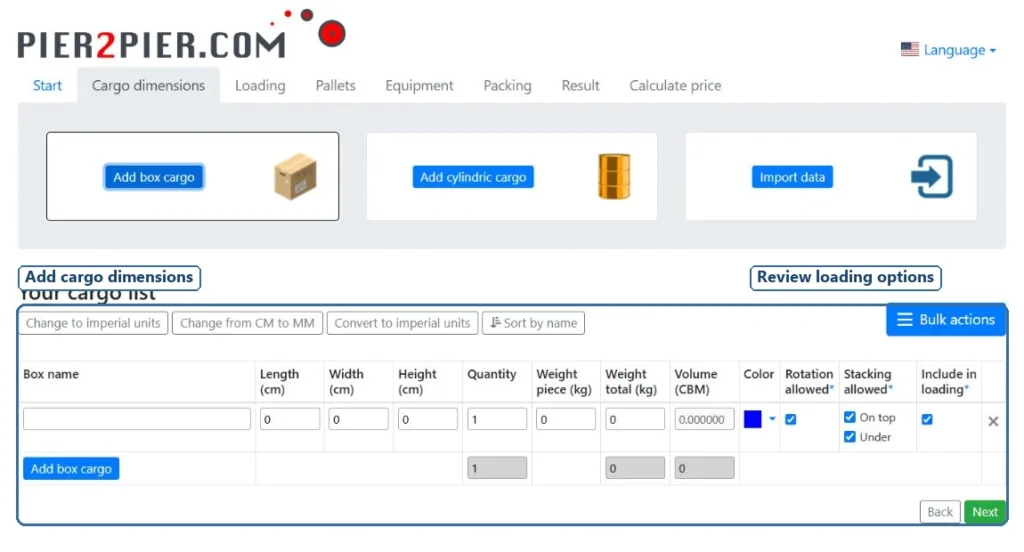
Pricing may depend on:
- actual weight;
- volumetric weight;
- chargeable weight.
That means a lightweight but bulky package can still produce a high air freight cost.
Before requesting an air quote, confirm:
- package count;
- dimensions;
- gross weight;
- total volume.
Useful tools include:
- volumetric-weight calculators;
- CBM calculators;
- freight calculators.
Without accurate shipment dimensions, the air-versus-sea comparison may be unreliable.
Step 4: Get Comparable Air and Sea Quotes
Do not compare:
Normalize both transport options through Compare Freight Quotes Apples to Apples so cost and service boundaries are aligned before the mode decision.
- a current air quotation;
- with an old estimated sea rate.
Both quotes should use the same:
- cargo;
- origin;
- destination;
- ready date;
- final delivery boundary.
Record:
| Item | Air | Sea |
|---|---|---|
| Freight Cost | $7,000 | $2,500 |
| Door-to-Door Lead Time | 7 days | 32 days |
| Forecast Delivery | 8 Sep | 2 Oct |
Once both options use the same shipment scope, procurement can make a meaningful decision.
Air vs Sea Freight Decision Matrix
| Factor | Air Freight | Sea Freight |
|---|---|---|
| Transport Speed | High | Lower |
| Freight Cost | High | Lower |
| Heavy / Bulky Cargo | Weak | Strong |
| Small Critical Parts | Strong | Often unnecessary |
| Large Project Quantities | Usually Weak | Strong |
| Schedule Buffer Required | Low | Higher |
| Project-Critical Urgency | Strong | Weak if schedule is insufficient |
| Routine Import Cost Efficiency | Lower | Strong |
This is directional only.
Actual cost and time depend on:
- route;
- cargo;
- carrier;
- season;
- handling;
- customs;
- destination.
Step 5: Calculate the Air Freight Premium
Example:
Sea Freight
$2,500
Air Freight
$7,000
Then:
Air Freight Premium = $7,000 − $2,500 = $4,500
A $4,500 premium may look expensive.
But procurement should not stop at the premium.
The next question is:
What does the extra $4,500 buy in time?
Step 6: Calculate Days Saved
Example:
Sea door-to-door lead time:
32 days
Air door-to-door lead time:
7 days
Therefore:
Days Saved = 32 − 7 = 25 days
Now the decision becomes more useful.
Freight Premium per Day Saved
A simple procurement metric is:
Freight Premium per Day Saved = Air Freight Premium ÷ Days Saved
Using the example:
Air Premium:
$4,500
Days Saved:
25
Therefore:
$4,500 ÷ 25 = $180 per day saved
Now procurement can ask:
Is protecting one project day worth more than $180?
For warehouse replenishment:
Probably not.
For a shipment blocking project completion:
Possibly yes.
This is a much stronger decision rule than simply saying air freight is expensive.
Compare the Freight Premium With the Cost of Delay
Late construction materials can create costs beyond freight.
Once the freight mode is commercially defined, carry the confirmed import inputs into the Landed Cost Calculator for Building Material Imports for total delivered-cost comparison.
Possible consequences include:
- idle installation labor;
- subcontractor standby;
- installation resequencing;
- additional site management;
- missed inspection;
- delayed room completion;
- delayed commissioning;
- delayed handover;
- acceleration costs elsewhere.
Procurement does not need a perfect theoretical delay-cost model.
It needs to ask:
What happens if this material arrives 10, 20 or 30 days late?
If the likely project impact is far larger than the freight premium, air freight may be commercially defensible.
The correct comparison is not Air Freight Cost vs Sea Freight Cost. It is Air Freight Premium vs Cost of Delay.
Required-Date Decision Gate
Use this simple process.
Can Sea Freight Meet the Required-on-Site Date With Adequate Buffer?
YES
→ Sea freight normally remains the preferred cost option.
NO
↓
Is the Material Project-Critical?
NO
→ Review schedule, substitute source or revised requirement.
YES
↓
Is Air Freight Operationally Feasible for the Cargo?
NO
→ Review other recovery options.
YES
↓
Obtain Air Freight Quote
↓
Calculate Freight Premium
↓
Calculate Days Saved
↓
Is the Premium Reasonable Compared With the Likely Delay Impact?
YES
→ Air freight may be justified.
NO
→ Review alternative schedule-recovery options.
Example: Urgent Shower Hardware for a Hotel Project
A hotel project needs:
200 sets of shower door hardware
Cargo Ready:
1 September
Required on Site:
30 September
Sea Freight
Door-to-Door Lead Time:
31 days
Forecast Delivery:
2 October
Freight Cost:
$2,200
Sea freight misses the requirement.
Air Freight
Door-to-Door Lead Time:
7 days
Forecast Delivery:
8 September
Freight Cost:
$5,800
Difference
Air Premium:
$5,800 − $2,200 = $3,600
Days Saved:
31 − 7 = 24 days
Premium per Day Saved:
$3,600 ÷ 24 = $150/day
If these 200 hardware sets are needed to finish 200 hotel bathrooms and installation cannot proceed without them, the $3,600 premium may be justified.
If the same shipment is only spare warehouse stock, it probably is not.
The material is identical.
The project consequence is different.
Why Air Freight Often Fails for Heavy Bulk Materials
Now consider a large shipment of tiles or sanitary ware.
The cargo is:
- heavy;
- bulky;
- high volume;
- low urgency.
Even if air freight saves 20 days, the premium may become disproportionately high.
For these materials, better procurement solutions may include:
- earlier ordering;
- stronger lead-time control;
- phased procurement;
- local buffer stock;
- schedule planning.
Air freight is not impossible.
It is simply less likely to be economically attractive.
Air vs Sea Freight by Material Type
| Material Type | Likely Direction |
|---|---|
| Small Replacement Hardware | Air can be practical |
| Missing Fittings | Air can be practical |
| Samples | Air often practical |
| Electronic Controls | Air can be practical |
| Urgent Installation Accessories | Air may be justified |
| Bulk Tiles | Sea usually stronger |
| Stone Slabs | Sea usually stronger |
| Large Glass Panels | Sea usually stronger |
| Full Sanitary Ware Shipment | Sea usually stronger |
| Full Project Quantity | Sea normally stronger |
The actual decision still depends on:
- dimensions;
- weight;
- packaging;
- route;
- required date;
- project impact.
Do Not Ignore Customs and Destination Handling
A short flight time does not mean the material is immediately usable.
Review unresolved destination and conditional charges with the Freight Quote Hidden Charges Checklist rather than comparing transport prices on incomplete scope.
Air freight can still require time for:
- pickup;
- export handling;
- customs documentation;
- import inspection;
- customs clearance;
- local delivery.
Therefore procurement should communicate:
Expected Material Available Date
rather than:
Flight Arrival Date
The same principle applies to sea freight.
A vessel arriving at port does not mean the material is already at site.
When Sea Freight Remains the Better Choice
Sea freight normally remains the stronger procurement option when:
- the required date has sufficient buffer;
- shipment quantity is large;
- cargo is heavy or bulky;
- freight cost is important;
- material is non-critical;
- project can tolerate the transit period.
Air freight should not become the default simply because the project team says something is “urgent.”
Urgency should be tested against the actual required date.
When Air Freight May Be Worth the Premium
Air freight becomes more defensible when:
- sea freight misses the required date;
- material is project-critical;
- shipment is relatively small;
- delay blocks installation or handover;
- freight premium is manageable;
- no suitable local replacement exists.
The useful rule is:
Urgency alone is not enough. Urgency + project criticality + feasible shipment economics is what matters.
What About Partial Air Freight?
Sometimes the full order does not need to move by air.
Example:
Total quantity:
1,000 units
Urgent requirement:
100 units
Procurement may consider:
- 100 units by air;
- balance by sea.
This can protect the project without paying air freight on the full quantity.
However, once procurement starts deciding:
- how much to expedite;
- which batch moves first;
- whether to split the shipment;
- how to recover the schedule;
the task becomes a broader schedule-recovery decision.
That should be handled separately.
Common Air vs Sea Freight Decision Mistakes
Choosing Air Just Because It Is Faster
Speed only creates value if it protects a real schedule requirement.
Choosing Sea Just Because It Is Cheaper
A late shipment can create a larger project cost.
Comparing Port-to-Port With Door-to-Door
Normalize both cost and lead time.
Ignoring Chargeable Weight
Air freight economics depend heavily on dimensions and weight.
Ignoring Customs and Final Delivery
Transport time is not the same as material availability.
Ignoring Project Criticality
A small fitting may be more urgent than a full container of stock.
Using Online Average Freight Rates as the Final Decision
Use current quotations for the actual shipment.
Air vs Sea Freight Procurement Checklist
Before choosing the transport mode, confirm:
- Material identified
- Quantity confirmed
- Gross weight confirmed
- Dimensions confirmed
- CBM confirmed
- Cargo-ready date confirmed
- Required-on-site date confirmed
- Sea door-to-door lead time obtained
- Air door-to-door lead time obtained
- Sea freight quote obtained
- Air freight quote obtained
- Schedule buffer calculated
- Material criticality assessed
- Air freight premium calculated
- Days saved calculated
- Premium per day saved calculated
- Customs and destination time considered
- Delay impact considered
- Transport mode selected
- Split-shipment option escalated if required
Tools and Resources for Air vs Sea Freight Decisions
Procurement teams may use:
- air freight calculators;
- sea freight calculators;
- freight quotation platforms;
- volumetric-weight calculators;
- CBM calculators;
- freight forwarder directories;
- shipping schedule tools;
- container tracking tools;
- landed-cost calculators.
Build Procurement Hub organizes these resources around the actual procurement decision.
The workflow is:
Weight and Dimensions
From:
Supplier Packing List
↓
Chargeable Weight
From:
Volumetric Weight Calculator
↓
Sea Volume
From:
CBM / Container Calculator
↓
Freight Cost
From:
Freight Forwarder / Quote Platform
↓
Transit Time
From:
Carrier / Shipping Schedule
↓
Final Cost
From:
Landed Cost Calculator
The goal is not simply to give procurement a list of freight websites.
It is to show:
Which tool provides each input required to make the decision.
Where Air vs Sea Freight Fits in the Procurement Workflow
The full workflow becomes:
After booking, move into Container Tracking Tools for Procurement Teams for shipment visibility; if the shipment still threatens schedule, use Procurement Expediting for recovery and escalation.
Material Requirement
↓
Cargo Ready
↓
Choose Air or Sea Freight
↓
Compare Freight Quotes
↓
Check Included / Excluded Freight Costs
↓
Calculate Landed Cost
↓
Book Freight
↓
Track Shipment
↓
Material Delivered
If one transport mode cannot recover the required schedule:
→ Evaluate partial air freight, split shipment or another schedule-recovery option.
The core principle is simple:
Choose air or sea freight based on whether the material can meet the required-on-site date at an acceptable total cost—not simply on which mode has the lower freight rate.
Choose Freight Mode by Required Date, Project Criticality and Total Cost
Start with the required-on-site date, compare door-to-door lead time, confirm weight and volume, obtain current air and sea quotes, calculate the freight premium and days saved, and decide whether the time protected is worth the extra logistics cost.
