Where to Check Current Import Duty and Tariff Rates for Building Materials
Once a building material has been classified under the correct HS, HTS, or national commodity code, procurement still needs to answer another question:
What import duty currently applies to this product on this trade route?
That answer cannot usually be determined from the product name alone.
Import-cost rule: current duty depends on classification, origin, destination and applicable trade treatment. Use the destination market's official tariff source and record the lookup date before using the result in landed-cost analysis.
A reliable import duty lookup normally requires at least:
- tariff or commodity code;
- country of origin;
- destination country;
- current tariff information.
The same construction product may face different tariff treatment depending on where it is manufactured and where it is imported.
That is why procurement teams should avoid maintaining static internal lists such as:
Tiles — 8% duty Hardware — 5% duty Sanitary ware — 10% duty
Those numbers can become misleading.
A better process is:
Verified Tariff Code
↓
Confirm Origin
↓
Confirm Destination
↓
Use Official Tariff Resource
↓
Check General Duty
↓
Check Preferential Treatment
↓
Check Additional Measures
↓
Record Current Result
↓
Use It in Landed-Cost Calculation
The objective is not to memorize tariff rates.
It is to build a repeatable method for checking the current applicable rate.
What Information Do You Need Before an Import Duty Lookup?
Do not begin with:
“What is the import duty on porcelain tiles?”
Start with a complete lookup input.
For example:
| Input | Example |
|---|---|
| Product | Porcelain Tile |
| Tariff Code | XXXXX |
| Origin Country | China |
| Destination Country | United Kingdom |
| Customs Value | $25,000 |
| Import Date | Current Shipment |
| Preferential Agreement? | Check |
At minimum, procurement should know:
- Product Description
- Tariff / Commodity Code
- Country of Origin
- Destination Country
Useful additional information includes:
- planned import date;
- customs value;
- supplier origin documentation;
- possible trade-agreement eligibility.
A product name without a tariff code and trade route is not enough for a reliable duty lookup.
Step 1: Confirm the Tariff Code First
Import duty lookup should come after classification.
If the classification has not yet been checked, complete How to Verify an HS / HTS Code for Building Materials before using any tariff percentage in a sourcing or landed-cost decision.
The workflow is:
Product
→ HS / HTS / Commodity Code
→ Duty Lookup
not:
Product Name
→ Guess Duty Rate
If the supplier provides a code but the classification has not been checked, verify it before using the rate for a sourcing or landed-cost decision.
A wrong tariff code can produce a perfectly calculated but completely wrong import-cost estimate.
Step 2: Confirm Country of Origin and Destination
Do not record only:
Shipping From: Country A
You may need to distinguish:
Country of Origin
Where the goods qualify as originating.
Country of Export
Where the shipment physically leaves from.
Destination Country
Where the goods enter customs.
These can be different.
For example, a product manufactured in one country may be stored and shipped from another.
This matters because preferential tariffs or additional trade measures may depend on origin, not simply where the container departed.
At this stage, procurement does not need to perform a complete rules-of-origin analysis.
It does need to know:
Which origin should be used when checking the tariff treatment?
Step 3: Use the Official Tariff Resource for the Destination Market
Once the tariff code and trade route are known, use an official or authoritative tariff source.
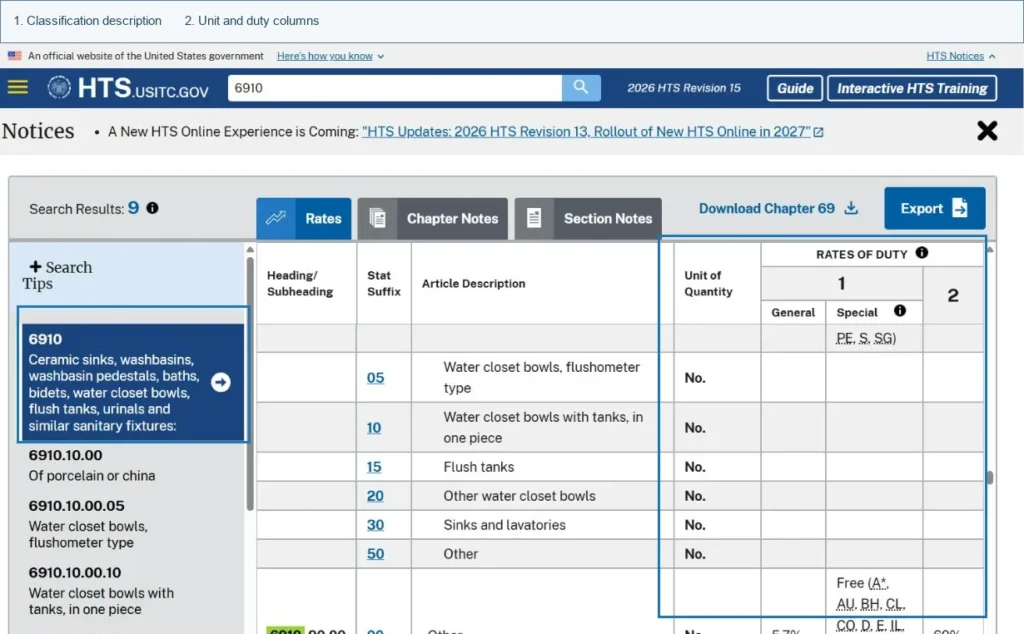
Different markets use different systems.
Importing Into the United States
Start with the U.S. Harmonized Tariff Schedule (HTS).
Use it to:
- locate the applicable HTS line;
- review tariff-rate columns;
- check relevant notes;
- identify whether further trade measures may need investigation.
For shipment-level decisions, the destination country's official tariff system should take priority over random third-party duty calculators.
Importing Into the European Union
Use Access2Markets or the relevant EU tariff resources.
These are particularly useful because EU import analysis can involve more than the basic customs duty.
Procurement may need to review:
- tariff rate;
- country of origin;
- preferential treatment;
- taxes;
- import requirements;
- rules-of-origin information.
For buyers comparing several source countries, this can be much more useful than a simple percentage calculator.
Importing Into the United Kingdom
Use the UK Trade Tariff.
The lookup process can help connect:
- commodity code;
- customs duty;
- VAT;
- tariff reductions or suspensions;
- relevant import measures.
Again, do not treat the first percentage on the page as the entire import cost.
Comparing Multiple Countries
For early-stage sourcing research, broader international tariff databases can help compare tariff environments across markets.
These are useful when procurement is asking:
Should we source this product from Country A, Country B, or Country C?
But for an actual shipment, confirm the result again using the destination market's official tariff source.
Official Tariff Resource Comparison
| Import Market | Primary Resource Type | Best For |
|---|---|---|
| United States | U.S. HTS | U.S. tariff classification and rates |
| European Union | Access2Markets / EU tariff tools | Tariff, origin and import-condition checks |
| United Kingdom | UK Trade Tariff | Commodity code, duty and VAT |
| Multiple Countries | International tariff databases | Early cross-market research |
The important question is not:
Which tariff website is best?
It is:
Which official source applies to the destination market I am actually importing into?
Step 4: Record the General or MFN Duty Rate
Once you have opened the correct tariff line, identify the standard rate.
Depending on the system, it may appear as:
- General Rate;
- MFN Rate;
- Third-Country Duty;
- Standard Customs Duty.
Record it.
For example:
General Duty: X%
But do not stop here.
The general rate may not be the final rate applicable to the shipment.
The next question is:
Does the product qualify for preferential treatment because of its origin?
Step 5: Check Preferential Tariff Treatment
Trade agreements can sometimes reduce the customs duty below the general rate.
Possible outcomes include:
- reduced duty;
- zero duty;
- preferential tariff treatment.
But supplier location alone is not enough.
A supplier may operate in a country that has a trade agreement with the destination market, while the product itself may not satisfy the relevant origin requirements.
Therefore procurement should record separately:
- General / MFN Rate
- Preferential Rate
- Relevant Trade Agreement
- Origin Evidence Required
- Eligibility Status
For example:
| Field | Result |
|---|---|
| General Rate | X% |
| Preferential Rate | Y% |
| Agreement | Relevant FTA |
| Origin Evidence | Required |
| Eligibility | To Confirm |
Do not apply the lower preferential rate until origin eligibility is reasonably confirmed.
Step 6: Check Additional Duties and Trade Measures
The base customs tariff may not be the only trade measure affecting an import.
Depending on the product and trade route, procurement may need to check for:
- anti-dumping duties;
- countervailing duties;
- additional tariffs;
- safeguard measures;
- tariff-rate quotas;
- temporary suspensions;
- special restrictions.
This is particularly important for high-value or high-volume imports.
Imagine the tariff database shows:
Base Duty: 3%
That looks attractive.
But if an additional trade measure also applies, the real tariff exposure could be materially different.
A low base tariff does not automatically mean a low effective import tariff.
When the financial impact is large, involve the appropriate customs or trade-compliance expertise rather than assuming the base rate is sufficient.
Step 7: Keep Customs Duty Separate From VAT or GST
Procurement teams sometimes put all border charges under one heading:
If supplier quotations mix duty, tax, freight, broker fees or port charges into one unclear total, resolve those commercial boundaries first using Supplier Quote Exclusions & Clarifications.
Import Duty
That makes landed-cost analysis harder.
Keep the categories separate.
Customs Duty
A tariff imposed on imported goods.
Import VAT / GST
A consumption tax charged at import in many markets.
Other Border or Logistics Costs
Potentially including:
- customs processing fees;
- broker fees;
- port charges;
- inspection fees;
- local delivery.
For example:
| Cost Type | Rate / Amount |
|---|---|
| Customs Duty | X% |
| Import VAT / GST | Y% |
| Additional Trade Duty | Z% |
| Broker / Port Fees | Calculate separately |
This prepares the data for the landed-cost calculation later.
Step 8: Understand That the Rate Is Not Yet the Duty Amount
G02 should answer:
What rate or tariff treatment applies?
It should not yet answer:
How much will we actually pay?
The final customs-duty amount can depend on the applicable customs valuation basis.
Depending on the jurisdiction and transaction, this may involve:
- goods value;
- freight;
- insurance;
- assists;
- other additions or adjustments.
That calculation belongs in the landed-cost stage.
Keep the sequence clear:
Tariff Rate
→ Customs Valuation
→ Duty Amount
→ Total Landed Cost
Record the Duty Lookup Result
Do not look up the rate and then close the browser.
Create a repeatable tariff record.
Useful fields include:
- Product
- Supplier
- Tariff Code
- Country of Origin
- Destination Country
- General / MFN Rate
- Preferential Rate
- Trade Agreement
- Additional Duty / Measure
- Import VAT / GST
- Official Source
- Lookup Date
- Notes
- Verified By
Example:
| Product | Code | Origin | Destination | General Rate | Preferential | Additional Measures | Checked |
|---|---|---|---|---|---|---|---|
| Porcelain Tile | XXXXX | Country A | UK | X% | Check | Check | Aug 2026 |
| Door Hardware | XXXXX | Country B | EU | X% | Y% if eligible | Check | Aug 2026 |
The most important field here is often overlooked:
Lookup Date
Tariffs and trade measures can change.
A procurement record should show when the information was checked.
Which Duty Rate Should Procurement Use?
Use a simple decision process.
No Preferential Treatment Available
Use:
Applicable General / MFN Rate
while also checking whether other trade measures apply.
Preferential Agreement May Apply
Check:
- origin eligibility;
- documentation;
- applicable preferential rate.
If confirmed:
Use Preferential Rate
If not confirmed:
Do not assume it.
Additional Trade Measures Apply
Record them separately.
For example:
Base Duty
Additional Tariff
Do not combine everything into one unexplained percentage.
Rate Remains Unclear
Do not choose whichever source gives the lowest result.
Escalate to:
- customs broker;
- trade-compliance specialist;
- customs authority;
- appropriate official guidance.
Example Import Duty Lookup Workflow
Suppose procurement is evaluating imported architectural hardware.
Inputs
Product: Architectural Hardware Origin: Country A Destination: Country B Tariff Code: Verified XXXXX
Step 1
Open the destination market's official tariff database.
Step 2
Search the exact tariff code.
Step 3
Record the standard customs duty.
Step 4
Check the country of origin.
Step 5
Determine whether preferential treatment may apply.
Step 6
Check for additional tariffs or other trade measures.
Step 7
Record VAT / GST separately.
Step 8
Save:
- source;
- lookup date;
- notes.
The output is:
Current Tariff Record
not yet:
Final Landed Cost
What If Different Websites Show Different Duty Rates?
This is common.
Different sources may show different results because:
- one uses outdated tariff data;
- one shows only the six-digit HS code;
- another uses a more detailed national tariff line;
- one shows MFN treatment;
- another shows preferential treatment;
- one assumes a different country of origin;
- additional tariffs may be included in one result but not another.
Do not average the numbers.
Use a source hierarchy.
First
Destination-Country Official Tariff Source
Then
Official Customs Guidance
Then
Trusted International Trade Database
Last
Third-Party Calculator
If two credible sources disagree, determine why.
The difference often reveals an assumption that has not been defined correctly.
When Should Procurement Recheck the Duty Rate?
Duty lookup should not always be treated as permanent master data.
Recheck when:
- the supplier changes country;
- manufacturing origin changes;
- tariff classification changes;
- a shipment occurs much later than the original quotation;
- new trade measures are introduced;
- preferential agreement eligibility changes;
- procurement switches to a different product configuration.
For recurring imports, a practical control is:
Revalidate important tariff treatment before major PO or shipment release.
This is especially useful when the duty materially affects supplier selection.
Common Import Duty Lookup Mistakes
Checking Duty Before Confirming the Tariff Code
Wrong classification produces wrong tariff data.
Verify classification first.
Ignoring Country of Origin
Origin may affect:
- preferential rates;
- additional tariffs;
- trade measures.
Using a Static Blog Article as Current Tariff Data
Tariff information can change.
Use current official resources.
Reading Only the General Rate
The shipment may qualify for preferential treatment or be subject to additional measures.
Confusing Customs Duty With VAT / GST
Record them separately.
They play different roles in landed-cost analysis.
Using the Supplier's Duty Rate Without Checking
The supplier may be looking at:
- another destination;
- its export-country tariff system;
- an old rate;
- a different product code.
Check the importing country's current rules.
Reusing an Old Duty Rate Forever
Keep a lookup date and revalidate when the risk is material.
Import Duty Lookup Checklist
Before moving into landed-cost calculation, confirm:
- Product classification confirmed
- Destination-country tariff code confirmed
- Country of origin confirmed
- Country of export distinguished from origin
- Destination country confirmed
- Official tariff resource selected
- General / MFN duty checked
- Preferential rate checked
- Rules-of-origin requirement flagged
- Additional tariffs checked
- Tariff quota / suspension checked where relevant
- Import VAT / GST recorded separately
- Official source recorded
- Lookup date recorded
- Conflicting sources resolved
- Result ready for landed-cost calculation
Tools and Resources for Import Duty Lookup
International building-material buyers may use:
- official customs tariff databases;
- HTS and commodity-code lookup tools;
- import-duty databases;
- rules-of-origin resources;
- trade-agreement databases;
- customs guidance;
- landed-cost calculators.
These resources solve different parts of the job.
An HS / HTS tool helps determine classification.
A tariff database shows current tariff treatment.
An origin tool helps evaluate preferential eligibility.
A landed-cost calculator combines the resulting costs.
Build Procurement Hub organizes these resources around the import procurement workflow so buyers can move from classification to duty lookup and landed-cost analysis without relying on static tariff tables.
What Comes After the Duty Rate Is Confirmed?
Once procurement has recorded:
Once classification, duty, tax and freight assumptions are normalized, use Construction Material Quotation Comparison and Construction Bid Leveling so supplier offers are compared on the same landed-cost and scope basis.
- tariff code;
- origin;
- destination;
- standard duty;
- preferential treatment where applicable;
- additional tariff measures;
- VAT / GST information;
the next question becomes:
What is the actual delivered cost of this import?
The workflow is:
Verify HS / HTS Code
↓
Check Current Import Duty
↓
Confirm Origin Treatment
↓
Check Additional Duties
↓
Record VAT / GST
↓
Calculate Landed Cost
↓
Compare Supplier / Import Route
This separation prevents one of the most common sourcing mistakes: comparing supplier prices before understanding the import costs attached to them.
An import duty rate is not a permanent percentage attached to a product. It is a current tariff result based on classification, origin, destination, and applicable trade treatment — so procurement should verify it from an authoritative source whenever the financial risk is meaningful.
Use Current Tariff Treatment — Not Static Product Percentages
Verify the tariff code, confirm origin and destination, use the official tariff resource for the importing market, record general and preferential treatment separately, and check additional measures before using the result in landed-cost analysis.
FAQ
Where can I check current import duty rates?
Start with the official tariff or customs resource for the destination market. Examples include the U.S. HTS for U.S. imports, EU tariff and Access2Markets resources for the European Union, and the UK Trade Tariff for the United Kingdom.
What information do I need to check import duty?
At minimum, you generally need the applicable tariff code, country of origin, and destination country.
Is the general tariff rate always the rate I will pay?
No. Preferential trade agreements, rules of origin, additional duties, quotas, suspensions, or other trade measures may affect the applicable rate.
Is import duty the same as import VAT?
No. Customs duty and import VAT or GST are separate charges and should be recorded separately before calculating the total landed cost.
