How to Verify an HS / HTS Code for Building Materials Before Import
A supplier sends you a quotation for construction materials and includes an HS code.
It is tempting to copy that number directly into the purchase order, freight documents, or import-cost calculation.
That can be a mistake.
Import rule: treat the supplier's HS code as a candidate, classify the actual goods crossing the border, confirm the destination-country tariff code through authoritative resources, and document why the working classification was selected.
The supplier's code may be a useful starting point, but procurement still needs to ask:
Does this code actually describe the product being imported, and is it the correct tariff classification for the destination country?
This matters because construction materials are not classified under one universal “building materials” category.
A shipment could contain:
- glass;
- aluminium profiles;
- steel hardware;
- ceramic products;
- sanitary ware;
- electrical equipment;
- complete doors;
- individual components;
- composite systems.
Classification depends on what is actually crossing the border.
A practical verification workflow is:
Describe the Product
↓
Record Supplier-Proposed Code
↓
Search Official Tariff
↓
Read Heading and Subheading
↓
Check Legal Notes
↓
Review Classification Guidance if Needed
↓
Confirm Destination-Country Code
↓
Document Why the Code Was Selected
Once the classification is reasonably confirmed, procurement can move to the next question:
What duty rate applies to this import?
HS Code vs HTS Code vs National Tariff Code
These terms are related, but they should not always be treated as interchangeable.
HS Code
The Harmonized System provides an international structure for classifying traded goods.
The internationally harmonized part is generally based on the first six digits.
HTS or National Tariff Code
Importing countries can extend the HS structure with additional digits for:
- national tariff treatment;
- trade statistics;
- customs administration.
For example, an importer may identify the international HS classification first and then use a more detailed national tariff code for customs entry.
This creates an important procurement rule:
Do not assume that a complete 8-, 10-, or longer-digit tariff number provided by an overseas supplier is automatically the full code required in the destination country.
The practical question is:
What is the underlying HS classification, and what tariff code applies in the country where the goods will be imported?
Why “Building Materials HS Code” Is Too Broad
“Building materials” is a commercial category.
It is not one customs classification.
Consider a hotel bathroom package.
It may contain:
- tempered glass;
- aluminium profiles;
- stainless-steel fittings;
- ceramic basins;
- brass valves;
- mirrors;
- lighting products.
They may all be “building materials” to the project procurement team, but customs classification considers the actual goods.
Classification may depend on:
- material composition;
- principal function;
- product form;
- degree of processing;
- whether the shipment contains a complete product or only parts;
- specific tariff wording.
Therefore, avoid starting with:
What is the HS code for building materials?
Start with:
What exactly are we importing?
Step 1: Describe the Product Before Searching for a Code
Weak product descriptions create weak classification decisions.
If the shipment description is still too vague, tighten the requested technical and commercial information in How to Prepare an RFQ for Construction Materials and keep the procurement package description consistent with the BOQ Template for Construction Procurement.
For example:
Shower door
does not provide enough detail.
A better description might be:
Complete framed sliding shower enclosure set containing tempered safety glass panels, aluminium profiles, rollers and stainless-steel hardware.
Useful information to collect includes:
- Product Name
- Commercial Description
- Main Material
- Material Composition
- Product Function
- Complete Product or Part
- Finished or Semi-Finished
- Key Components
- Relevant Technical Characteristics
- How the Product Is Shipped
This is especially important for construction systems made from several materials.
The project may call something:
Door System
but the shipment may contain only:
aluminium profiles and hardware.
Those are not necessarily the same classification problem.
Classify the imported goods, not just the project name used in the BOQ.
Step 2: Treat the Supplier's HS Code as a Candidate
Suppliers often provide HS codes because they have shipped similar products before.
Where the supplier's quotation leaves unclear whether freight, duty, packing or import-related responsibilities are included, resolve that scope first using Supplier Quote Exclusions & Clarifications instead of treating the quoted total as a comparable landed cost.
That information can be useful.
But procurement should treat it as:
Candidate Code
rather than:
Automatically Verified Code
Use this process:
Supplier Provides Code
↓
Record It
↓
Check Product Description
↓
Check Official Tariff
↓
Confirm or Change
When requesting the code from a supplier, also ask for:
- the product description used for classification;
- whether the code relates to the complete product or components;
- previous export destinations where relevant;
- any classification explanation they already use.
This can help identify whether both parties are talking about the same goods.
Step 3: Search the Official Tariff System
Once you have a candidate code and a clear product description, move to the official tariff or customs classification resource used by the destination country.
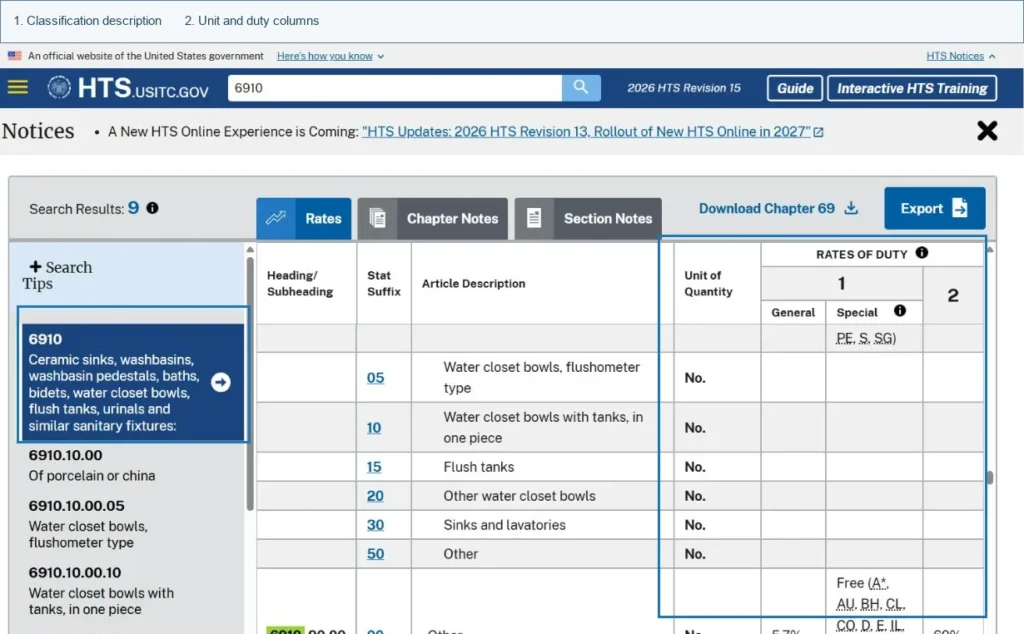
Search using:
- candidate tariff code;
- product name;
- main material;
- product function.
Third-party HS lookup tools can be useful for initial discovery, but they should not automatically replace official tariff information.
A practical approach is:
Broad Chapter
↓
Heading
↓
Subheading
↓
Country-Specific Tariff Line
Do not jump directly to a very specific code because a search engine returned a similar product description.
Read how the tariff itself describes the goods.
Step 4: Read the Heading and Subheading Wording
Keyword matching alone is not enough.
Suppose you import a stainless-steel bathroom product.
A tariff search may return several classifications containing words such as:
- steel;
- fittings;
- sanitary;
- parts;
- household articles.
The correct answer cannot be chosen simply because one result “sounds close.”
Check:
- Does the heading describe the product's function?
- Is it limited to a particular material?
- Is there a more specific heading for the product?
- Does the heading apply to complete products or only parts?
Tariff classification should follow the legal description of the goods, not just a commercial keyword match.
This is why detailed product descriptions are so important.
Step 5: Check Section and Chapter Notes
This step is often skipped in quick HS-code searches.
It should not be.
Tariff sections and chapters may contain legal notes that:
- define a category;
- include certain products;
- exclude certain products;
- clarify how parts are handled;
- redirect particular goods elsewhere.
The workflow becomes:
Candidate Heading
↓
Read Heading
↓
Check Relevant Notes
↓
Product Included
Continue.
Product Excluded
Search another heading.
A heading may initially look correct but still be inappropriate because of an exclusion elsewhere in the tariff structure.
This is one reason procurement should avoid relying only on a supplier spreadsheet or generic online HS finder.
Step 6: Check Whether You Are Importing a Complete Product or Parts
Construction procurement frequently deals with systems rather than single-material products.
Examples include:
- complete door set vs hinges;
- complete shower enclosure vs hardware kit;
- complete window vs aluminium profiles;
- light fixture vs electrical components;
- sanitary fitting vs spare cartridge.
Ask:
What exactly is included in this shipment?
The answer may affect classification.
Also confirm whether the goods are:
- assembled;
- unassembled;
- incomplete;
- components only;
- raw or semi-finished materials.
For example, the project may purchase a “shower enclosure system,” but one shipment could contain only fittings while glass is sourced locally.
Do not automatically reuse the same code for both arrangements.
Step 7: Check Similar Classification Guidance or Rulings
Some products are easy to classify.
Others are not.
Extra research becomes more important for:
- composite products;
- kits;
- multifunction products;
- parts;
- systems made from several materials;
- products that appear to fit more than one heading.
Where available, review:
- official customs classification guidance;
- customs rulings;
- examples involving similar products.
But compare the facts carefully.
A ruling for one product may involve:
- different materials;
- different functions;
- different components.
A similar product name does not automatically mean the same classification.
Compare product characteristics, not only product names.
Step 8: Confirm the Destination-Country Tariff Code
Once the basic HS classification is identified, confirm the full tariff number required by the destination country.
Record:
- Destination Country
- HS Heading
- HS Subheading
- National Tariff Code
- Official Source
- Verification Date
This is especially important when a procurement team buys from one country and imports into another.
The supplier may be familiar with the code used on exports from its own country.
The buyer must still make sure the import declaration uses the appropriate destination-country tariff classification.
HS / HTS Verification Checklist
Use the following questions before treating a code as confirmed.
| Check | Question |
|---|---|
| Product Identity | What exactly is being imported? |
| Composition | What materials is the product made from? |
| Function | What is its principal function? |
| Product Form | Complete product, kit, component or raw material? |
| Supplier Code | What code has the supplier proposed? |
| Candidate Heading | Which official tariff heading appears relevant? |
| Legal Description | Does the heading actually describe the product? |
| Section / Chapter Notes | Do any notes include or exclude the goods? |
| Guidance / Rulings | Is there relevant official classification guidance? |
| Destination Tariff | What national tariff code applies? |
| Final Basis | Why was this code selected? |
This creates a repeatable process instead of relying on memory.
Example: Checking a Supplier-Provided Code
Suppose procurement is importing a:
Framed sliding shower enclosure
The supplier provides an HS code.
Do not immediately approve it.
Step 1 — Confirm What Is Being Shipped
Ask:
- Is tempered glass included?
- Is the aluminium frame included?
- Are rollers and handles included?
- Is it a complete set?
- Is it shipped assembled or unassembled?
- Is glass sourced locally instead?
These details can materially change the classification question.
Step 2 — Record the Supplier Code
Keep it as:
Supplier-Proposed Classification
Do not overwrite it later.
This preserves the audit trail.
Step 3 — Search the Official Tariff
Search the candidate classification and relevant product descriptions.
Review headings that may apply to:
- complete articles;
- glass products;
- aluminium products;
- fittings or components;
depending on what is actually imported.
Step 4 — Review Legal Notes
Check whether the relevant tariff sections contain definitions or exclusions that affect the proposed classification.
Step 5 — Confirm the Destination-Country Code
If a clear classification is identified:
Confirmed
If the product remains ambiguous:
Needs Classification Advice
The objective is not to force an answer when uncertainty remains.
It is to identify uncertainty before the goods reach customs.
What If Two HS Codes Both Look Possible?
Do not select the code because:
- it has the lowest duty;
- the supplier prefers it;
- it was used on an old shipment;
- one online calculator suggested it.
Instead compare:
- Product description
- Material composition
- Product function
- Complete vs component status
- Heading wording
- Section and Chapter Notes
- Relevant official guidance
If both classifications still appear plausible, escalate the issue.
Depending on the country and transaction, this may involve:
- customs broker;
- customs classification specialist;
- customs authority;
- formal advance or binding classification process where available.
Classification uncertainty is better resolved before shipment than during customs clearance.
When Should Procurement Escalate the Classification?
Not every import needs specialist classification work.
Escalation becomes more appropriate when:
- two headings remain plausible;
- the product combines several materials;
- it is a complex kit or system;
- duty differences are significant;
- additional trade measures may depend on the code;
- import value is high;
- the classification will be reused for many future shipments;
- customs has challenged the product before.
The greater the commercial impact, the less sensible it is to guess.
Record the Classification Basis
A procurement database should not contain only:
HS Code: XXXXX
Create a simple classification record.
Useful fields include:
- Product
- Supplier
- Product Description
- Main Material
- Supplier-Proposed Code
- Final Working Code
- Destination Country
- Official Tariff Source
- Verification Date
- Classification Notes
- Relevant Guidance / Ruling
- Confirmed By
Why keep this information?
Because products change.
A supplier may later change:
- material;
- thickness;
- components;
- configuration;
- shipment form.
If the actual imported article changes, the old classification may need to be reviewed.
Supplier Code vs Verified Code
| Supplier-Proposed Code | Procurement-Verified Code |
|---|---|
| Provided by exporter | Checked for destination-country import |
| Useful starting point | Final working classification |
| May reflect previous export practice | Based on current product configuration |
| May need clarification | Has documented classification basis |
The important distinction is:
Code supplied is not the same as code verified.
Common HS / HTS Classification Mistakes
Copying the Supplier's Code Without Checking
Supplier information can be useful, but it should be reviewed against the actual product and destination tariff.
Searching Only by Marketing Name
Customs classification may depend more heavily on:
- material;
- function;
- components;
- shipment form.
Using a Random Online HS Finder as Final Authority
Use third-party tools for discovery if useful.
Confirm through authoritative tariff resources.
Ignoring Section and Chapter Notes
A seemingly correct heading may still contain exclusions or definitions that change the result.
Using the Same Full Tariff Code in Every Country
The internationally harmonized portion and national tariff extensions are not the same thing.
Confirm the destination-country code.
Classifying the Installed System Instead of the Imported Goods
A project package may be larger than the physical contents of one shipment.
Classify what crosses the border.
Selecting the Code With the Lowest Duty
Classification should determine duty.
Duty should not determine classification.
Reusing an Old Code After the Product Changes
Material or configuration changes may require a new classification review.
HS / HTS Verification Checklist for Procurement
Before moving to duty lookup, confirm:
- Exact product identified
- Commercial description is clear
- Main material recorded
- Composition understood
- Product function understood
- Complete vs component status confirmed
- Supplier-proposed code recorded
- Official tariff searched
- Heading wording reviewed
- Subheading reviewed
- Relevant Section / Chapter Notes checked
- Similar guidance or rulings checked if necessary
- Destination-country tariff code confirmed
- Material ambiguity escalated where needed
- Final classification basis documented
- Verification date recorded
- Product changes trigger classification review
Tools and Resources for HS / HTS Verification
Construction procurement teams may use several resource types during import classification:
- official tariff databases;
- HS / HTS search tools;
- customs classification resources;
- customs ruling databases;
- import duty databases;
- customs broker resources;
- freight and landed-cost tools.
The important part is using them in the correct order.
A tariff database helps establish classification.
A customs ruling resource may help resolve ambiguity.
A duty database is used after the classification is known.
A landed-cost tool comes later.
Build Procurement Hub organizes these resources around the actual import procurement workflow so buyers can move from product classification to duty lookup and landed-cost calculation without treating all customs tools as interchangeable.
What Comes After the HS / HTS Code Is Verified?
Once the classification is reasonably confirmed, the next task is:
After classification, duty and freight assumptions are established, move the normalized landed-cost result into Construction Material Quotation Comparison so supplier prices are compared on the same commercial basis.
What import duty applies?
The workflow becomes:
Product Identified
↓
Verify HS / HTS Classification
↓
Confirm Destination-Country Tariff Code
↓
Check Duty Rate
↓
Check Origin and Additional Trade Treatment
↓
Calculate Freight and Landed Cost
↓
Import / Supplier Decision
This separation matters.
Do not try to calculate import cost before the product classification is reasonably established.
A wrong tariff code can make the entire duty and landed-cost calculation unreliable.
An HS or HTS code should be based on the actual imported product and the applicable tariff classification — not copied automatically from a supplier invoice, marketplace listing, or old shipment record.
Verify the Classification Before You Calculate Import Cost
Use Freight & Import Duty resources to check the destination-country tariff classification, record the basis for the working code, and only then move into duty, freight and landed-cost calculation.
FAQ
Can I use the HS code provided by my supplier?
You can use it as a starting point. However, procurement should check it against the actual product description and the tariff system used by the destination country before treating it as confirmed.
Is an HS code the same in every country?
The Harmonized System provides a shared international classification structure, while individual countries may extend it with additional tariff digits and national requirements.
What information is needed to verify an HS code?
You normally need a clear product description, material composition, principal function, shipment form, whether the item is complete or a component, and the destination country's tariff schedule.
What should I do if two tariff codes appear possible?
Compare the legal heading descriptions, relevant Section and Chapter Notes, product characteristics, and available official guidance. If material uncertainty remains, seek appropriate customs or classification advice before relying on the code.
